The social, political, economic, and environmental impacts bananas yield is vast. It is one of the world’s major food crops and is an essential part of the diets of millions all over the world. In some countries, bananas are the main export. If a country’s most important export were to become effects, this could potentially destroy them. The resurgence of Panama disease can cause financial hardship, unemployment, displacement, and social/political unrest (Dita 102).
The production and sales can be split into two groups: Local farmers and large corporations. The major global producers of bananas are Dole, Del Monte, Chiquita, and Fyffes. These companies own and control most of the worlds production and sale
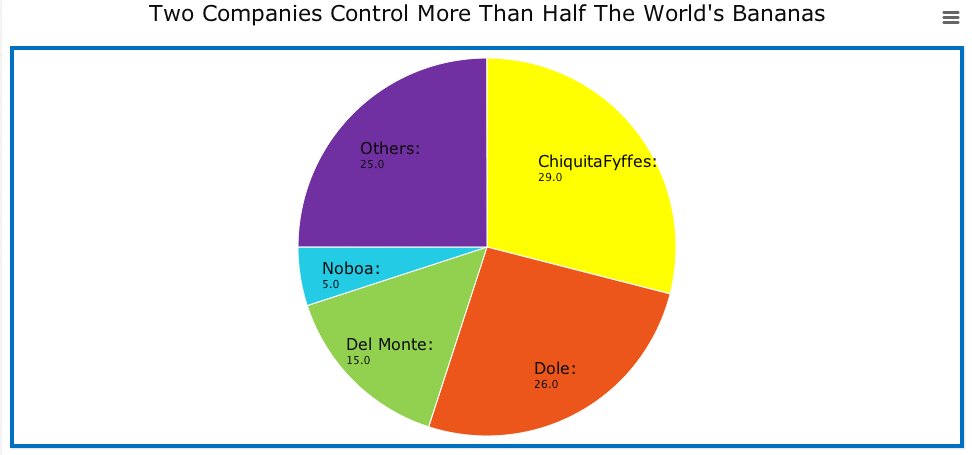
Fortunately bananas are one of the cheapest crops that almost anyone can get their hands on. Its ability to grow in multiple environments make it one of the most favorable crops to grow. Many factors, ranging from farm logistics to employee costs can influence the cost of bananas. Bananas are cheap because the business is notorious for underpaying workers in developing countries (Fassler). Many countries that grow bananas do not have solidified infrastructures to enforce work laws that would properly compensate their employees. These companies take advantage of this to be able to produce bananas at their cheap prices.
All of these companies rely on the high demand that bananas have. Once this demand decreases, the prices would increase to compensate. Other factors involving the cost of bananas are worker strikes or devastating disease. Over the past decade, the prices have remained steady.

Bananas are propagated vegetatively rather than sexually because nearly all cultivated varieties are seedless. Whether it be via banana propagation (division of pups) by small-holder farms or micropropagation, the production of bananas require a highly involved process to grow and harvest crops. Extensive manual labor is required to propagate as the workers have to divide suckers or pups which arise from the base of the main stem, work that is time and labor intensive.

Although banana farming doesn’t have any obvious positive impacts on the environment; there are a few notable negative impacts. The most devastating impact is deforestation (muohio.edu). Typically, a portion of tropical rainforest must be cleared in order to farm. When fields have become infected with disease, the first course of action is to find new terrain and burn the entire plantation down. The negative effects of deforestation are loss of carbon sink, loss of wildlife habitat, soil nutrient depletion, and soil erosion. If the farmers decide to use pesticides instead of relocating, many of the excess chemicals used find their way to the water table and create large issues than intended.
 Daniel and Bailey's Banana Biotechnology Blog